


The fund is live, the press release is out, and the AUM looks solid. For most new issuers, it feels like the hard part is over. It isn’t.
 What happens after launch — how your fund trades, how it is quoted, and whether advisors can confidently get in and out — determines whether your ETF builds real distribution or stalls on the low-volume shelf.
The Liquidity Misconception That Stalls Distribution
The most common assumption from new issuers: AUM equals liquidity. It does not.
The structural driver of ETF liquidity is the hedgeability of the underlying basket. AllianceBernstein argues directly that an ETF’s AUM and trading volume are not reliable indicators of true liquidity, because the creation and redemption mechanism allows market makers to transfer the liquidity of the underlying basket into the ETF itself. UBS makes the same point from a different angle: liquidity depends less on historical trading activity and more on whether the underlying securities can be efficiently hedged and sourced when demand shows up.¹
$19.4M tradeexecuted at zero price impact in a fund with only $47M AUM and $746K average daily volume. |
Volume and trading history still matter — for a different reason. They drive platform approvals and advisor confidence. They signal operational health and market acceptance, but they do not determine whether a large trade can be absorbed cleanly. A smaller ETF holding highly liquid underlying securities can be easier to move in size than a larger ETF built on a thinner basket. Understanding that distinction changes how you communicate your fund’s capability to distribution partners.²
Secondary market liquidity — the spreads advisors see on screen, the ease of execution, the ability to exit without friction — is built over time. For larger trades, advisors are typically routed through capital markets desks that access primary market liquidity directly. On-screen NBBO understates actual executable size, so funds that look illiquid on screen often carry far more real capacity than displayed volume suggests.
What Market Makers Are Watching
Market makers post continuous bids and offers on your ETF, keeping spreads tight and price close to NAV. The primary driver of how aggressively they quote is the hedgeability of your underlying basket. The easier it is to hedge the underlying exposure, the tighter they can price. More complex strategies — options-based, multi-asset, or those with less liquid underlyings — carry wider spreads by design. That is pricing reality, not a flaw.
They are also watching whether an issuer understands the difference between launching with assets and launching with tradable momentum. Seed capital — including 351 conversions — can help create a stronger start, but it does not eliminate the need to build volume, advisor usability, and confidence in how the ETF trades over time. Inflows and marketing activity influence how much balance sheet a market maker deploys, but they are secondary. A dormant fund gets wider spreads because market makers are pricing in demand uncertainty — not because liquidity has structurally changed.³
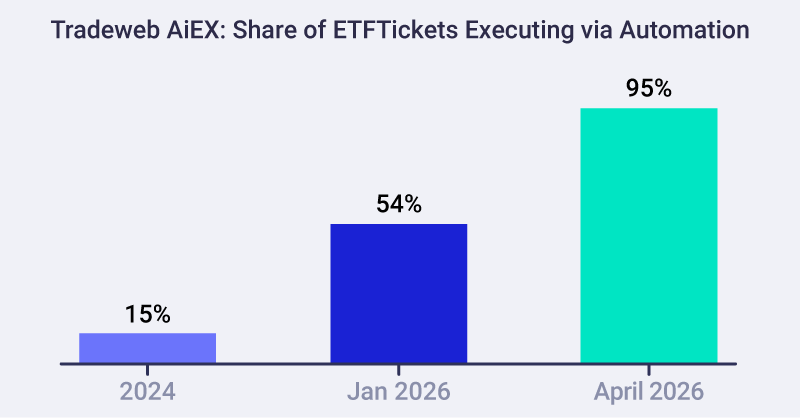
AiEX accounted for 54% of U.S. ETF tickets on Tradeweb in January 2026 and 95% by April 2026.
Automation is no longer a side theme in ETF execution — it is becoming part of the market structure itself. Tradeweb’s 2026 updates show automated execution accounting for 54% of U.S. ETF tickets in January and 95% by April. Routing, hedging, and pricing are faster than at any prior point in the market’s history. But the first layer of liquidity for any new fund is still built through direct engagement: getting on a market maker’s radar before launch, walking them through the strategy, and establishing communication lines that hold when spreads widen.⁴
Platform Approvals and What They Require
Broad distribution through wirehouses and RIA platforms means your liquidity profile becomes a formal gating factor. Platforms have gotten considerably more rigorous — partly because the universe of ETFs they are evaluating has exploded.
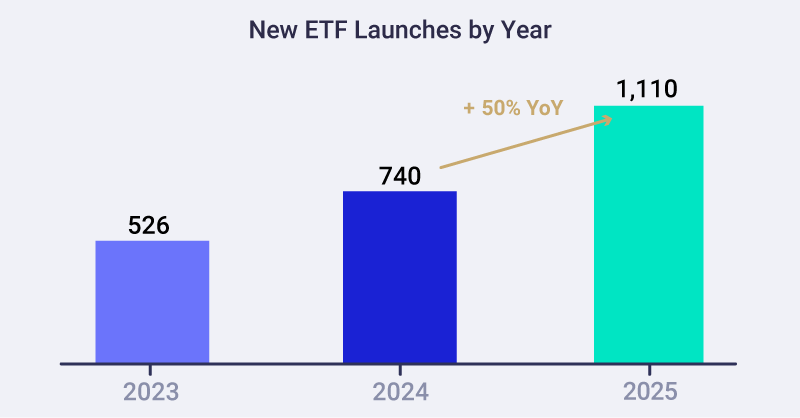
1,110 new ETFs launched in 2025 — a 50% year-over-year increase, with more than 80% being active strategies.
Platforms now evaluate funds across a far larger and more complex universe. They want to know how the fund trades day-to-day, whether spreads are consistent, and whether advisors can execute without meaningful market impact. Six to twelve months of live trading history is standard before most platforms will consider a fund. Spread consistency and managed premiums and discounts are evaluated alongside raw volume.⁵
The 351 exchange is widely misunderstood here. Seeding via 351 conversion addresses AUM thresholds and gives a fund a meaningful head start, but it does not replace trading history. Platforms are increasingly asking whether volume exists organically — whether real advisors are actually using the product. And being approved for a platform is distinct from being on a recommended or model list, which takes considerably longer and requires a sustained trading track record.
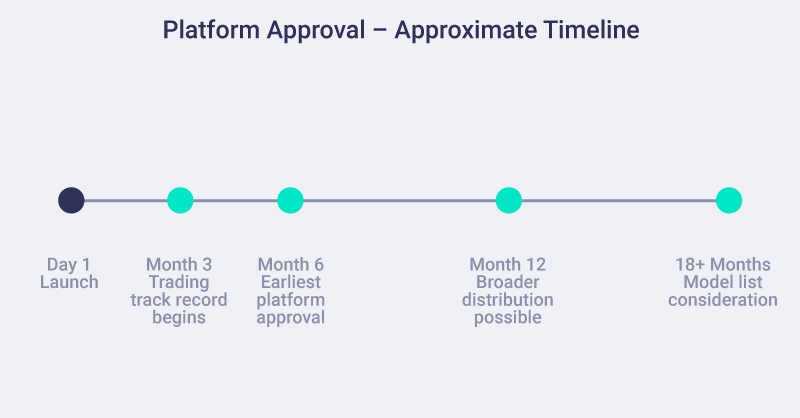
Approximate milestones from launch to model list consideration. Timelines vary by platform and strategy type.
The 90 Days After Launch
Most ETF industry education focuses on what happens before Day 1 — structure selection, seed capital, regulatory approval. The 90 days after launch get far less attention, despite being the most consequential period for long-term liquidity.
Volume building and distribution are not separate workstreams. Distribution creates liquidity; liquidity enables more distribution. Equip your wholesalers and distribution partners with plain-language explanations of how your fund trades — advisors who do not understand primary versus secondary liquidity will either avoid the fund or sell at the wrong time.
| Focus Area | What It Means in Practice |
| Market-maker Coordination | Active relationships from Day 1. Know your spreads. Have a protocol when they widen. |
| Block Trade Readiness | Capital markets contacts with a clear large-order workflow before advisors ask. |
| Volume Building | Advisor outreach and model portfolio conversations are liquidity infrastructure, not separate marketing. |
| Advisor Education | Plain-language explanations of primary vs. secondary liquidity, and how to trade the fund in size. |
| Spread Expectations | Frame complexity-driven spreads as fair pricing, not flaws. Get ahead of the conversation before advisors see the screen. |
Options-Based and Complex Strategies
Options-based, leveraged, and defined-outcome ETFs are among the fastest-growing segments of the market. They also come with a distinct liquidity profile that issuers need to frame clearly for advisors. Market makers quoting these products are hedging across multiple dimensions — not just the ETF basket, but the options or derivatives exposure underneath it. That complexity has a cost, and it shows up in wider spreads. It is appropriate. An options-based ETF with a wider spread is not a poorly constructed product. It is a fairly priced one.
80%+ activeof the 1,110 ETFs launched in 2025 were active strategies — many with complex underlying exposures. |
Getting ahead of that conversation — before an advisor sees the spread on screen for the first time — protects a fund’s early trading reputation. The explanation is simple once you have it ready.
How ETC Supports Post-Launch Liquidity
ETC’s role extends well beyond fund launch. As a portfolio management and white-label platform partner, we bring capital markets expertise directly into the issuance process — from pre-launch market-maker introductions to post-launch trading monitoring and distribution support. We help issuers build the 90-day plan, frame their liquidity story for platforms, and ensure the operational infrastructure supports the trading outcomes advisors need.
If you are planning a launch, a conversion, or scaling an existing fund, talk to the ETC team: Contact us here.>>
exchangetradedconcepts.com.
QUICK REFERENCE · LIQUIDITY FAQ
ETF Liquidity: What Really Matters
What does ETF liquidity really mean?
ETF liquidity is the ability to move meaningful size in an ETF without causing a large or unexpected price impact. It comes from two layers: the secondary market, where investors trade ETF shares, and the primary market, where market makers create or redeem shares using the underlying basket. In practice, true liquidity depends on how easily the underlying securities can be hedged and sourced — not just on yesterday’s trading volume.
Why isn’t ETF trading volume the same thing as liquidity?
Average daily volume shows how often an ETF traded in the past. It does not show how much size a market maker can source today through creation and redemption. Research from AllianceBernstein and UBS reaches the same conclusion: the liquidity of the underlying holdings matters more than on-screen volume when evaluating real execution capacity.
How should issuers evaluate ETF liquidity?
Start with the basket. Look at the liquidity of the underlying securities, expected bid-ask spreads, and how difficult the portfolio is to hedge. Then look at how the ETF trades in practice — spread behavior, depth, and how block orders are handled. For larger trades, direct conversations with a market maker or capital markets desk are often more useful than relying on headline ADV or AUM alone.
Does fund size tell me how liquid an ETF is?
Not by itself. A larger ETF may have more established demand, but that does not automatically make it easier to trade if the underlying securities are thin or difficult to hedge. A smaller ETF holding liquid large-cap equities can be easier to move in size than a larger ETF holding less liquid credit or niche exposures.
How does automation affect ETF liquidity?
Automation is becoming a larger part of ETF execution because it standardizes workflows, speeds RFQ and order handling, and routes lower-touch orders more efficiently. Tradeweb’s 2026 updates show automated ETF ticket flow through AiEX growing materially — a signal that execution is becoming more system-driven, not relationship-only.
Why does underlying basket liquidity matter so much?
The underlying basket is the real source of ETF liquidity. If the stocks, bonds, or other instruments inside the ETF are liquid and easy to hedge, market makers can usually quote tighter spreads and accommodate larger trades. If the underlying assets are thin or harder to hedge, spreads widen and trading costs rise, even when the ETF looks active on screen.
Sources
1. AllianceBernstein, “Gauging ETF Liquidity: Look Beyond Volume and Fund Size,” alliancebernstein.com
2. UBS Asset Management, “Top ETF Misconceptions Debunked,” ubs.com
3. Tradeweb Markets, “Exchange-Traded Funds Update — January 2026” and “April 2026”; AiEX Automated Trading, tradeweb.com
4. ETFGI Global ETF Industry Insights; Bloomberg Intelligence ETF Research, 2025, etfgi.com
5. SEI, “Gateway to ETFs: Platform Approval Process,” September 2024, seic.com
Exchange Traded Concepts, LLC (“ETC”) is an SEC Registered Investment Adviser. ETC presently offers two lines of business, the first being the provision of white-label ETF services, that include investment advisory and administrative platform services, and the second is offering its portfolio management services on a stand-alone basis to other advisers managing funds that have a need for a specialized trading sub-adviser familiar with and skilled in trading on behalf of an ETF and other investment vehicles. ETC provides the trust, board, and decades of experience to offer asset managers (hedge, SMAs, mutual) and others an efficient, cost-effective means to leverage the benefits of the ETF wrapper. ETC’s Form ADV can be found here https://adviserinfo.sec.gov/firm/summary/151197

Important Disclosures
Exchange Traded Concepts is an SEC Registered Investment Adviser. The Firm's Form ADV is publicly available and can be found here: https://www.adviserinfo.sec.gov/Firm/151197. ETC may be subject to various conflicts of interest in the provision of its services. Potential conflicts of interest shall be identified in the Firm's Form ADV. The Exchange Traded Funds are referred to as "Funds" for purposes of this document. ETC transacts business in the United States and other jurisdictions where it is properly registered or excluded or exempted from registration requirements. This document does not constitute an offer of services in jurisdictions where ETC does not have the necessary licenses.
No representation is made that any Fund's investment process, objectives, goals or risk management techniques will or are likely to be achieved or be successful or that any Fund or any underlying investment will make any profit or will not sustain losses. The risks of investing in a Fund will not be negated by ETC's Fund services, and no assurance is given that a Fund will not be exposed to risks of significant trading losses.
The information provided herein does not constitute tax, legal or accounting advice. ETC does not provide legal, financial, accounting or tax advice. Clients and prospective Clients, as well as investors and prospective investors in a Fund ("Investors") are advised to seek the counsel of their own legal, financial and tax advisors for all matters relating to the services and structures contemplated herein. Each Investor (either alone or with its professional advisors) is solely responsible for its own due diligence, risk assessment and tolerance, investment objectives, any decision to invest in a Fund, and for monitoring its investment for purposes of determining whether it wishes to remain invested in such product and whether such product continues to be appropriate for its circumstances and requirements.
The information provided herein: (a) is provided as of the date indicated, (b) is in summary only and is not complete, and (c) is subject to change at any time without notice. Certain information provided by ETC is based on third-party sources and, although generally believed to be reliable, has not been independently verified. ETC is not responsible for errors or omissions from these sources. No representation is made with respect to the accuracy, completeness, or timeliness of such information, and ETC assumes no obligation to update or otherwise revise such information. In no event will ETC be liable to any party for any direct, indirect, incidental, exemplary, compensatory, punitive, special or consequential damages, costs, expenses, legal fees or losses (including, without limitation, lost income or lost profits and opportunity costs) in connection with the use of the information contained herein, even if advised of the possibility of such damages. ETC and its respective employees and its affiliates hereby exclude, to the extent permitted by applicable law, all liability in connection with the use of the information herein.
Interests in Funds will not be insured by the FDIC, the SIPC or any other organization, will not be deposits of any bank, and are not guaranteed by any bank.